

The strange origins of astral projection.

What do the ancient Hindus, medieval civilizations, countless modern-day scientists and spiritual leaders have in common? They’ve all extensively documented the theory of astral travel, or out-of-body experiences (OBE)—the theory that it’s possible for a person to leave the physical body, and experience something beyond the physical realm.

This theory extends across the history of human civilization, touching virtually every corner of the globe—from the above-mentioned civilizations to Inuit, Amazonian and Japanese cultures. Various chapters in the Bible directly reference astral projection. The Yoga Vasistha, an ancient Hindu text, repeatedly speaks of leaving the confines of the physical body. In ancient Chinese scripture, the great Daoist sage Han Xiang Zi was said to have projected his consciousness into a room of people, as he lay fast asleep next door.
Fast forward to today, and you’ll realize similar experiences continue to be reported. The Dalai Lama has said that “consciousness can be trained to leave the physical body”. Studies have suggested that up to 5% of Americans have experienced some form of astral travel. And scientific journals have documented experiments where participants can be induced into an out of body experience.
Can you really induce an out of body experience?

Science Magazine, 24 August 2007
In August 2007, Science Magazine published a study by neuroscientist Dr. Henrik Ehrsson, who had devised an experimental method to induce an OBE in healthy participants. The experiment, involving a total of 42 people, was conducted at the UCL Institute of Neurology.
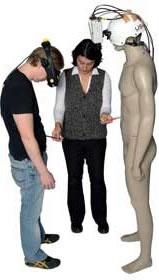
Dr. Ehrsson conducting an out-of-body experiment.
Participants were requested to sit in a chair and wear a pair of virtual reality goggles. The goggles had two small screens which showed live film recorded by two video cameras, placed side by side, two meters behind the participant’s head.
The image from the left video camera was presented on the left-eye display and images from the right camera fed to the right eye, allowing the person to see a stereoscopic (3D) image of their own image from behind.
In full view of the participant, Dr. Ehrsson stood beside them and used two plastic rods to simultaneously touch the participant’s actual chest out-of-view and the chest of the illusory body, moving the second rod towards where the illusory chest would be located, just below the camera’s view.
“It was quite a vivid experience for most people,” said Dr. Ehrsson. “Many of them giggled and said ‘Wow, this is so weird!’”.
Steve G. Jones
M.Ed., Clinical Hypnotherapist
Welcome to the world of astral projection. If you're new to this fascinating phenomenon I'm sure you have a ton of questions, which I hope this website can help you with. I've been astral projecting since I was a 17-year-old kid in military school, and since then I've gained a variety of qualifications and trained thousands of people across the world with my unique brand of astral projection through hypnosis and meditation.
Astral projection is a breathtaking, eye opening and life-changing adventure. It's the best thing that's ever happened to me, and once you learn how to do it, I know you'll feel the same. So thanks for dropping by, and remember to sign up for your complimentary Beginner's Guide to Astral Projection. It's the best way to start your journey!


“It’s like having your arm fall asleep.”

“There are several theories as to why people have OBEs,” says David Wilde, a scientist leading a study on OBEs at the University of Manchester. “A common link between them is the idea that in certain circumstances the brain somehow loses touch with sensory information coming in from the body. This triggers a series of psychological mechanisms which can lead to someone having an OBE.”
“It’s a little bit like if you sleep on your arm and lose sensation in it. Only with an OBE, the sensation loss is in the whole body and the brain’s response seems to be to create a feeling of separation from the self.“
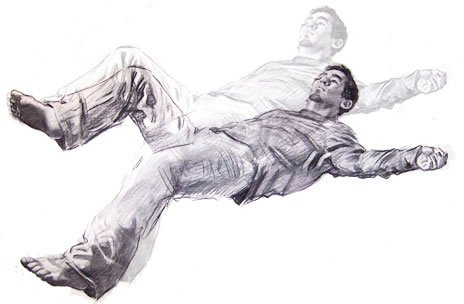
The spiritual explanation of astral projection.

The above experiment is however only the tip of the iceberg compared to what many people have reported experiencing. A 1992 Gallup Poll suggested that up to 5% of Americans have experienced at least some form of astral projection. Today, countless people across the world claim they are able to use this phenomenon for a variety of purposes. Some say it gives them spiritual clarity, some use it to enhance their intuition, some to gain a deeper understanding of the people and circumstances surrounding them, and some even to experience hyper-realistic dreams that allow them to project their consciousness to any location in the world.
The key to experiencing astral projection for yourself is to learn to see beyond the physical. Astral projection techniques operate on the belief that all living beings possess an astral body.
It is connected to the physical body through the umbilicus (your belly button) along what is known as the silver cord—and it is this astral body that you must learn to control.

Once you do, imagine the possibilities. Imagine being able to effectively part from your body and travel to another world where time, space, gravity and many other “laws” that exist in the 3rd dimension can no longer limit you. Imagine being able to tap into a sea of infinite wisdom, and use it to both elevate your spirituality, and your physical experience in tandem. It is believed astral travel can give you sensations, emotions, intuition and knowledge that you’d never otherwise have access to—and that’s why many call it the ultimate spiritual experience.
What happens when we cheat death?
Have you ever heard of someone who experienced a near-death situation – like a car crash or major surgery – and emerged transformed? Tens of millions of people across the world have reported going through the phenomenon known as a near death experience (NDE)–yet to this day, science still cannot fully explain its true nature.
In fact, according to the Near Death Experience Research Foundation, as of 2001, almost 600 adults per day in the United States experience an NDE.
Is an NDE a hallucination? A glimpse of the afterlife? The only thing we know for sure is that this phenomenon often has profound effects on those who experience it.
The nature of these experiences vary greatly from person to person.
Some report floating freely in dream-like abstract worlds, where the laws of physics no longer apply. Some claim to meet deceased loved ones, like their mothers, spouse or children. Some see alternate versions of themselves that chose different paths in life. And some claim to gain a new lease on life through profound personal revelations or wisdom.
Based on these descriptions, it’s clear that NDEs and astral projection share many similar traits–and many theorize that NDEs are in reality a form of astral projection.
The good news is that with astral projection, you don’t need to come close to death to experience these profounds visions and revelations.
How to induce conscious astral projection.


In essence, astral projection is a conscious out of body experience – and it can be triggered through both meditation and hypnosis. Once you learn to master these modalities, you will learn how to astral project whenever you want. And your astral projections aren’t a result of an external situation or circumstance which you have no control over, like surgery or with drugs.
Instead, you are choosing to achieve that state willingly; which is astral projection in its truest form. And this is what astral projection expert, Dr. Steve G Jones, Ed.D., has dedicated his life to mastering.
Dr. Steve’s experience with astral travel.
At the age of 15, Dr. Steve began an adventure that would change his life forever. When other kids were out playing, he was diving into books about hypnosis and mind power. Before long he had a working knowledge of the powers and applications of hypnosis—a skill he would soon put to good use.

Dr. Steve serving in the army.
A couple of years later, when he was attending Riverside Military Academy (1982-1985), something extraordinary happened. Dr. Steve had always wanted to travel the world, to see the Taj Mahal, the Great Pyramids of Giza, and the Eiffel Tower—but he never had the money or the time.
What he did have was knowledge. Applying everything he knew about the human mind, he achieved a state of hypnosis that led him to consciously astral project to wherever he wanted to go in seconds.

Since then, Dr. Steve has spent the past 25 years refining and testing his methodologies to a point of perfection. One of Dr. Steve’s most profound astral projection experiences came six years ago, when he had a vivid astral experience involving his deceased mother. He subsequently felt an intense and lasting sensation of joy, relief and peace—one that had eluded him since her death.
Today, Dr. Steve is a renowned astral projection and hypnosis trainer, with thousands of students across the world.
He’s authored over 22 books on hypnotherapy, and is the President of the American Alliance of Hypnotists.
Dr. Steve worked with a variety of Hollywood celebrities, including Tom Mancewicz, the writer of Superman: The Movie, and Danny Bonaduce.
Dr. Steve’s students have reported using his astral projection techniques to:
- Achieve their first astral projection experience and learn how to astral project consciously.
- Taste the nature of their true selves and achieve deeper spiritual clarity.
- Experience hyper-realistic dreams.
- Channel more positive energy into their careers and relationships.
- Feel more intuitive and creative in their careers and personal lives.
- Gain a better understanding of the people and situations surrounding them.
Take your first step towards astral projecting.
If you’d like to start astral projecting for yourself, sign up for the FREE Beginner’s Guide to Astral Projection on this page.
Don’t worry, you don’t need any prior experience or any form of meditation training whatsoever—just an open mind and a willingness to learn how to astral project.
This program is by far Dr. Steve’s most popular introductory material. It’s been downloaded over 45918 times worldwide since he released it in May 2010.
You can get started in minutes. Just sign up below for your free copy, and follow the simple instructions which will be emailed to you.

Why is Dr. Steve giving away this beginner’s guide for free?
“Astral projection is my passion, and I’d love nothing more than to share it with you. Plus once you understand it more through this beginner’s guide, I’m confident you’ll want to continue your journey with me through the programs I offer online. It’s a win-win situation for both parties.”

Here’s what you’ll receive when you sign up:
The 6-Part FREE Beginner’s Guide to Astral Projection
Part 1:
Preparing for lift-off
Preparation is key, so you’ll begin your journey by learning all the basic principles on how to astral project consciously, including a summary of benefits, the 5 stages of astral projection, and what exactly happens when you astral project.

Part 2:
Have you astral projected without knowing it?
A 1992 Gallup Poll showed that at least 5% of Americans have experienced some form of astral projection—have you? Find out the 10 tell-tale signs of astral projection, so you can be aware of it the next time it happens.

Part 3:
Your 5 bodies – The Physical, Etheric, Astral, Mental and Spiritual
Your physical body that you can see and touch is just the tip of the iceberg. Learn about the 4 other types of bodies you possess, and why they hold the key to both a better physical life and exhilarating astral journeys.

Part 4:
The 10 inhibitors of astral projection
Hidden subconscious fears, like the fear of not being able to return to your body, could be preventing you from experiencing astral projection. Learn 10 of the most common fears, and how to put them to rest for good.

Part 5:
3 essential astral projection techniques
There are many ways to achieve conscious astral projection, and you’ll need to experiment before you can find the one that suits you best. Here you’ll get to try 3 of the most widely used astral projection techniques for beginners.

Part 6:
The Chakra and Kundalini factor
A handy recap of the first five lessons, followed by a how-to guide on the final step for successful astral travel—raising your Kundalini energy, and clearing your energetic ecosystem (the Chakras).

Free Astral Projection Course
Enter your name and email address to get instant online access to the free 6-part Astral Projection Introductory Course.
No Credit Card Required.
Notice of Consent: By signing up above, you are agreeing to receive the free Beginners’ Guide to Astral Projection via email from theartofastralprojection.com. After submitting your information, you will occasionally receive updates and newsletters via email from theartofastralprojection.com. If you wish to stop receiving emails from us, you may unsubscribe at any time using the link provided in our emails.
Disclaimer: The information posted here by theartofastralprojection.com is not purposed to replace professional medical diagnosis, treatment or even advice. You should always consult a qualified healthcare professional with questions about any medical condition.